
How to monitor vendor terms of service without missing hidden risk

Stani Mihov
Founder & CEO
·
TL;DR
Vendor terms of service change more frequently than most organizations assume.
Unilateral update clauses allow vendors to modify contractual language without renegotiation.
Periodic reviews often fail to detect material shifts in liability, data use, or jurisdiction.
Effective monitoring requires structured change detection and impact assessment.
Terms visibility should be embedded within a continuous vendor risk monitoring framework.
Why monitoring vendor terms of service matters
In modern SaaS environments, vendor agreements are rarely static. Terms of service, privacy policies, and data processing agreements are updated regularly, often under unilateral modification clauses that permit vendors to change contractual language without renegotiation.
While these updates may appear administrative, they can materially affect liability allocation, data usage permissions, sub-processor disclosures, termination rights, or governing law provisions.
Organizations that rely solely on onboarding reviews or annual assessments operate under an assumption of contractual stability that no longer reflects operational reality.
The structural risk created by evolving vendor legal documents is explored in more detail in our analysis of the hidden risk of vendor legal changes.
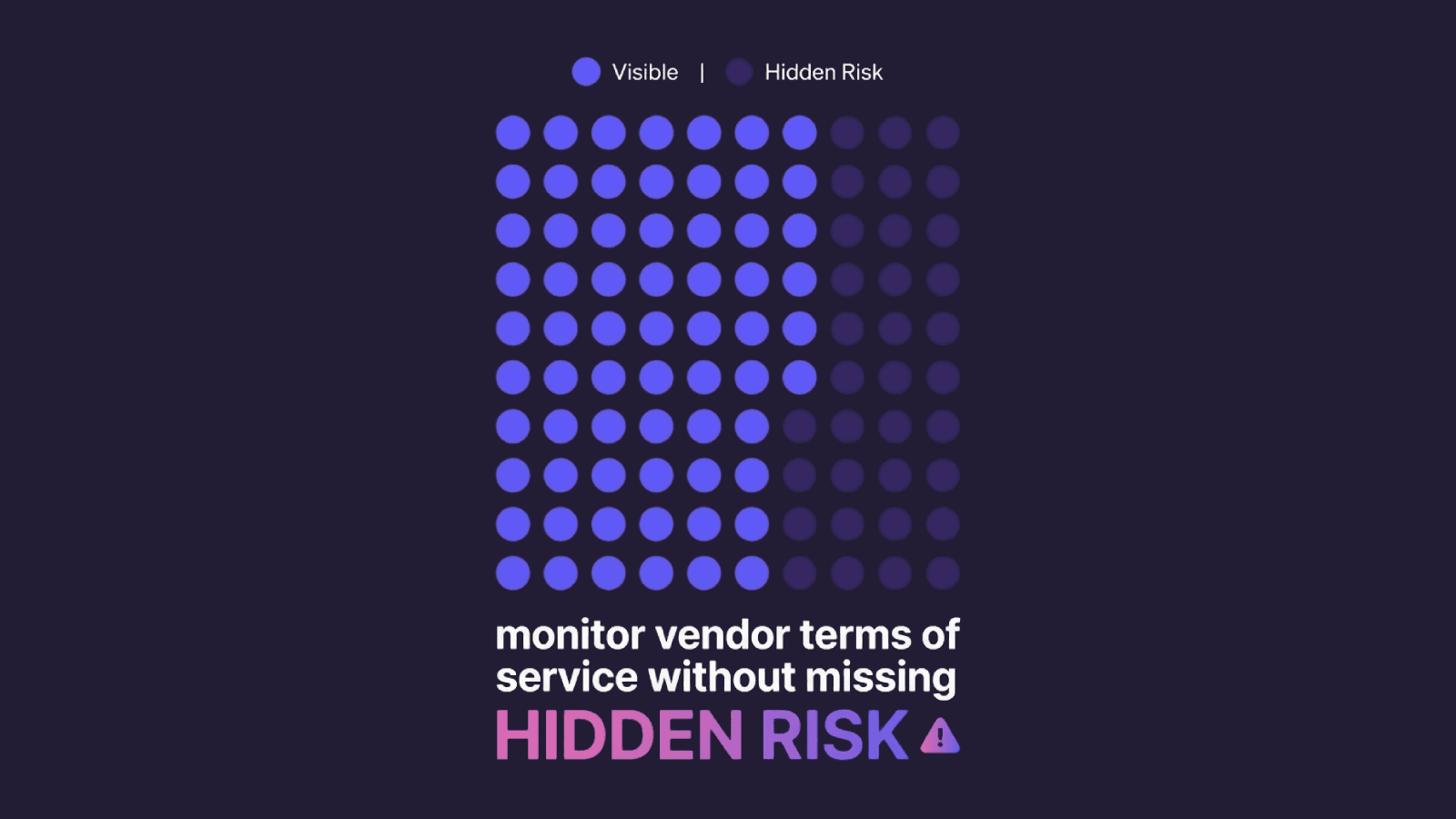
Monitoring vendor terms of service is therefore not about reacting to every wording revision. It is about maintaining visibility into contractual drift over time.
How vendor terms typically change
Most SaaS providers include clauses permitting them to update terms periodically, provided notice is given through email, dashboard notifications, or website updates.
In practice, this can mean:
A privacy policy expands the categories of data usage
A sub-processor list grows without direct negotiation
A limitation of liability clause is restructured
A governing law provision changes
Continued use is deemed acceptance of revised terms
Because these changes are embedded within updated documents, they often bypass structured internal review processes.
Risk exposure may shift quietly, without operational awareness.
The governance gap
The central challenge is not whether updates occur, but whether they are detected, assessed, and routed appropriately.
Many organizations attempt to manage vendor terms monitoring through calendar reminders, manual version comparisons, shared spreadsheets, or reliance on vendor notification emails.
These mechanisms provide partial visibility at best. They depend on timing, discipline, and consistent ownership across legal, compliance, and risk teams.
As vendor ecosystems expand, this approach becomes increasingly fragile.
Continuous vendor risk monitoring addresses this gap by aligning detection mechanisms with document behavior rather than with scheduled review cycles.
What effective vendor terms monitoring looks like
Effective monitoring of vendor terms of service requires structured capabilities:
Reliable change detection
Contextual impact assessment
Clearly defined ownership and escalation pathways
Proportionate response based on materiality
Not every update warrants escalation. The objective is to distinguish immaterial language refinements from changes that materially affect contractual, regulatory, or operational exposure.
When implemented as part of a broader continuous vendor risk monitoring framework, terms visibility becomes embedded in governance rather than treated as an administrative afterthought.
Monitoring terms of service as a structural control
Vendor terms of service define the boundaries of liability, data processing, jurisdiction, and operational expectations. When those boundaries shift, organizational risk shifts with them.
Treating terms monitoring as a periodic compliance task assumes stability that rarely exists in digital vendor ecosystems.
Instead, monitoring must reflect the dynamic nature of vendor legal documents.
Organizations that institutionalize structured visibility into vendor terms reduce the latency between contractual change and internal awareness. That reduction in latency separates reactive rediscovery from controlled oversight.
A deeper comparison between manual tracking methods and automated monitoring approaches is explored in our analysis of manual vs automated vendor monitoring.
Why monitoring vendor terms of service matters
In modern SaaS environments, vendor agreements are rarely static. Terms of service, privacy policies, and data processing agreements are updated regularly, often under unilateral modification clauses that permit vendors to change contractual language without renegotiation.
While these updates may appear administrative, they can materially affect liability allocation, data usage permissions, sub-processor disclosures, termination rights, or governing law provisions.
Organizations that rely solely on onboarding reviews or annual assessments operate under an assumption of contractual stability that no longer reflects operational reality.
The structural risk created by evolving vendor legal documents is explored in more detail in our analysis of the hidden risk of vendor legal changes.
Monitoring vendor terms of service is therefore not about reacting to every wording revision. It is about maintaining visibility into contractual drift over time.
How vendor terms typically change
Most SaaS providers include clauses permitting them to update terms periodically, provided notice is given through email, dashboard notifications, or website updates.
In practice, this can mean:
A privacy policy expands the categories of data usage
A sub-processor list grows without direct negotiation
A limitation of liability clause is restructured
A governing law provision changes
Continued use is deemed acceptance of revised terms
Because these changes are embedded within updated documents, they often bypass structured internal review processes.
Risk exposure may shift quietly, without operational awareness.
The governance gap
The central challenge is not whether updates occur, but whether they are detected, assessed, and routed appropriately.
Many organizations attempt to manage vendor terms monitoring through calendar reminders, manual version comparisons, shared spreadsheets, or reliance on vendor notification emails.
These mechanisms provide partial visibility at best. They depend on timing, discipline, and consistent ownership across legal, compliance, and risk teams.
As vendor ecosystems expand, this approach becomes increasingly fragile.
Continuous vendor risk monitoring addresses this gap by aligning detection mechanisms with document behavior rather than with scheduled review cycles.
What effective vendor terms monitoring looks like
Effective monitoring of vendor terms of service requires structured capabilities:
Reliable change detection
Contextual impact assessment
Clearly defined ownership and escalation pathways
Proportionate response based on materiality
Not every update warrants escalation. The objective is to distinguish immaterial language refinements from changes that materially affect contractual, regulatory, or operational exposure.
When implemented as part of a broader continuous vendor risk monitoring framework, terms visibility becomes embedded in governance rather than treated as an administrative afterthought.
Monitoring terms of service as a structural control
Vendor terms of service define the boundaries of liability, data processing, jurisdiction, and operational expectations. When those boundaries shift, organizational risk shifts with them.
Treating terms monitoring as a periodic compliance task assumes stability that rarely exists in digital vendor ecosystems.
Instead, monitoring must reflect the dynamic nature of vendor legal documents.
Organizations that institutionalize structured visibility into vendor terms reduce the latency between contractual change and internal awareness. That reduction in latency separates reactive rediscovery from controlled oversight.
A deeper comparison between manual tracking methods and automated monitoring approaches is explored in our analysis of manual vs automated vendor monitoring.
Real-time change notifications
Stay ahead of every legal change
Get updates, product news and expert tips on navigating legal changes
Dispute resolution clause now requires mandatory arbitration in all regions
Data retention period extended from 2 years to 5 years for all services
New restrictions on AI-generated content in product descriptions
Third-party data sharing expanded to include analytics partners
Real-time change notifications
Stay ahead of every legal change
Get updates, product news and expert tips on navigating legal changes
Dispute resolution clause now requires mandatory arbitration in all regions
Data retention period extended from 2 years to 5 years for all services
New restrictions on AI-generated content in product descriptions
Third-party data sharing expanded to include analytics partners